
De Quervain’s Tenosynovitis

Why Your Thumb and Wrist Might Be Hurting

Pain on the thumb side of your wrist can make even the simplest tasks frustrating – opening a jar, lifting a kettle, holding your phone, or picking up your child. If this sounds familiar, you may be experiencing De Quervain’s Tenosynovitis.

Although the name sounds complicated, the condition itself is quite common – and very treatable when addressed early.
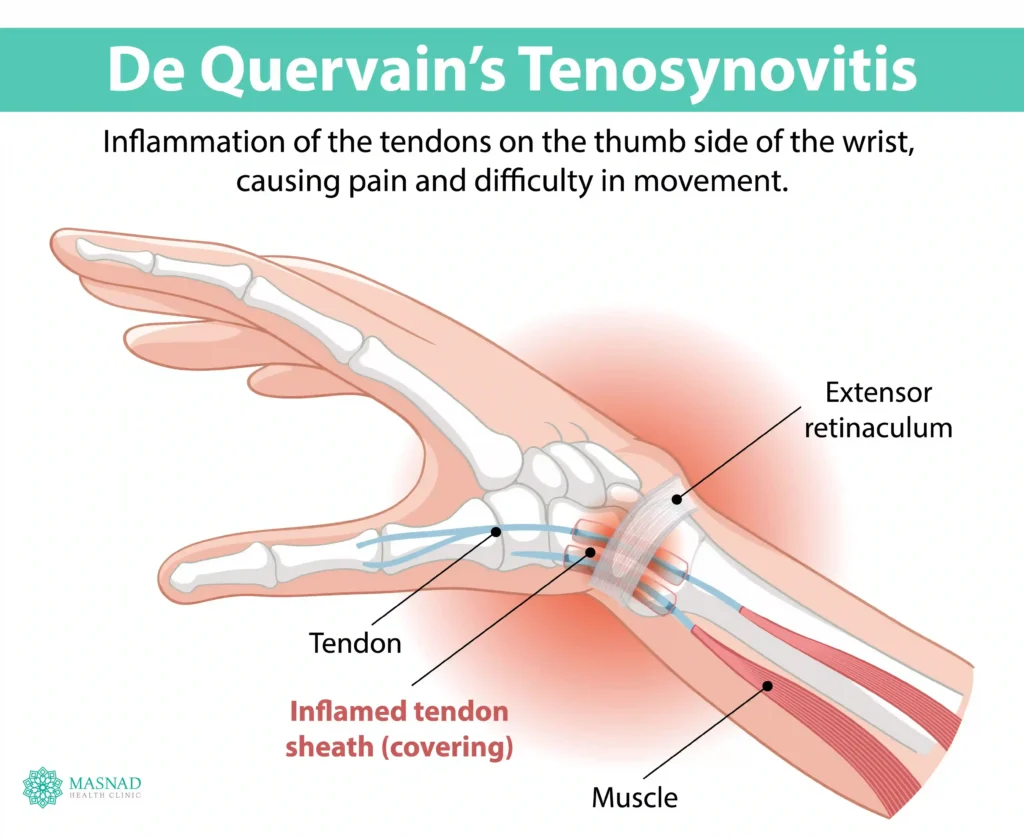

De Quervain’s Tenosynovitis

What Is De Quervain’s Tenosynovitis?

De Quervain’s Tenosynovitis is a condition that causes pain and swelling along the thumb side of the wrist.

Two important tendons help move your thumb:

  • Abductor Pollicis Longus (APL)
  • Extensor Pollicis Brevis (EPB)

These tendons travel through a small tunnel (called a tendon sheath) near the base of your thumb. When the tendons become irritated from overuse, the sheath can become inflamed and swollen. Because the space inside that tunnel is limited, swelling creates friction – and friction creates pain.

Over time, if the irritation continues, the sheath may thicken. This makes thumb movement more difficult and can increase discomfort.

What Are the Symptoms?

The most common symptom is pain at the base of the thumb, usually on the side of the wrist. This pain can:

  • Feel dull and achy or sharp with movement
  • Worsen when gripping, pinching, lifting, or twisting
  • Spread up into the forearm
  • Increase when using your phone or computer
  • Flare up when lifting a child

You might also notice:

  • Swelling near the base of the thumb
  • Tenderness when pressing that area
  • A catching or snapping sensation with movement
  • A small bump caused by tendon swelling
  • Stiffness or weakness in the thumb

Many people find that everyday activities gradually become more uncomfortable before they realise something isn’t right.

How Does It Develop?

De Quervain’s Tenosynovitis is usually caused by repetitive thumb and wrist movements.

Common contributing activities include:

  • Frequent texting or phone use
  • Lifting or carrying children
  • Golf, fishing, or racquet sports
  • Playing musical instruments
  • Manual work such as carpentry
  • Repetitive twisting or wringing motions

New mothers are particularly prone to this condition due to the repeated lifting and awkward wrist positioning involved in caring for a baby. This is sometimes referred to as “mum’s thumb.”

It’s rarely caused by a single injury. Instead, it tends to develop gradually from repeated strain without adequate recovery time.

Over time, ongoing irritation can lead to thickening of the tendon sheath and increased restriction of movement.

How Is It Diagnosed?

Diagnosis is typically straightforward.

Your physiotherapist will:

  • Ask detailed questions about your symptoms and activities
  • Examine your thumb and wrist
  • Assess strength and movement
  • Perform a simple clinical test called the Finkelstein test

During this test, you tuck your thumb into your palm, make a fist, and gently bend your wrist toward your little finger. If this movement produces sharp pain along the thumb side of the wrist, it strongly suggests De Quervain’s Tenosynovitis.

No scans are usually required unless symptoms are severe or not improving.

How Can Physiotherapy Help?

The goal of physiotherapy is to reduce pain, calm inflammation, and gradually restore normal movement and strength.

Treatment may include:

1. Reducing Irritation

Early management focuses on settling the irritated tendons. This may involve:

  • Temporary modification of aggravating activities
  • Wearing a supportive thumb or wrist splint
  • Ice or heat as appropriate
  • Advice around workload and rest

In some cases, your GP may recommend anti-inflammatory medication.

2. Improving Biomechanics

Often, the thumb pain is only part of the picture.

Your physiotherapist will assess:

  • Wrist positioning
  • Forearm strength
  • Grip patterns
  • Shoulder and upper limb mechanics

Addressing these factors reduces stress on the thumb tendons and helps prevent recurrence.

3. Strength and Mobility Work

Once pain begins to settle, targeted exercises are introduced to:

  • Improve tendon capacity
  • Restore thumb strength
  • Increase wrist stability
  • Improve grip endurance

This stage is important. Rest alone may calm symptoms temporarily, but building resilience helps prevent the issue from returning.

4. When Is Further Treatment Needed?

If symptoms do not improve with conservative management, your GP may discuss options such as:

  • Corticosteroid injection
  • Platelet-rich plasma (PRP) therapy

In rare and persistent cases, a minor surgical procedure may be performed to release the tight tendon sheath. This is typically straightforward and has good outcomes.

Most people improve well with early physiotherapy and activity modification.

When Should You Seek Help?

It’s a good idea to seek professional advice if:

  • Pain persists for more than a couple of weeks
  • Thumb movement becomes increasingly restricted
  • Everyday activities are becoming difficult
  • Symptoms are worsening despite rest

Early treatment usually means faster recovery.

Final Thoughts

De Quervain’s Tenosynovitis can feel frustrating because it interferes with simple daily tasks. The good news is that it responds well to the right care.

If you’re experiencing thumb or wrist pain and it’s affecting your work, sport, or ability to care for your family, don’t ignore it.

How Masnad Health Clinic Can Support You

At Masnad Health Clinic, our physiotherapists provide comprehensive assessment and evidence-based treatment for thumb and wrist pain, including De Quervain’s Tenosynovitis.

We focus on:

  • Identifying the underlying mechanical cause
  • Reducing tendon irritation safely
  • Improving wrist and thumb biomechanics
  • Strengthening for long-term prevention
  • Providing clear guidance throughout recovery

Our multidisciplinary approach ensures the entire upper limb and movement system is assessed – not just the wrist.

Book an Appointment

If you are experiencing persistent pain along the thumb side of your wrist:

Book your appointment online today
Or call us on (02) 9793 8840

Early treatment can prevent symptoms from becoming long-term.

We proudly support the communities of Bankstown, Lakemba, Punchbowl, Greenacre, Chullora and Yagoona with personalised, professional physiotherapy care.

FAQs

With appropriate treatment, many cases improve within several weeks. Persistent or untreated cases may take longer to settle.

Mild cases may improve with rest and activity modification, but targeted physiotherapy significantly improves recovery and reduces recurrence risk.

A thumb or wrist splint may be recommended temporarily to reduce irritation, depending on your symptoms and clinical findings.

Modified activity is often possible. Your physiotherapist will guide you on safe levels of movement during recovery.

Recurrence is possible if repetitive strain continues without correction. Prevention strategies form part of long-term management.