
Femoroacetabular Impingement (FAI)

Femoroacetabular Impingement (FAI): Symptoms, Causes and Treatment

Overview

Femoroacetabular Impingement (FAI) is a condition where the hip joint does not move smoothly due to abnormal contact between the ball (femoral head) and the socket (acetabulum). This abnormal friction can lead to pain, stiffness, and reduced mobility. If left untreated, FAI can contribute to early hip osteoarthritis, making timely diagnosis and treatment essential.
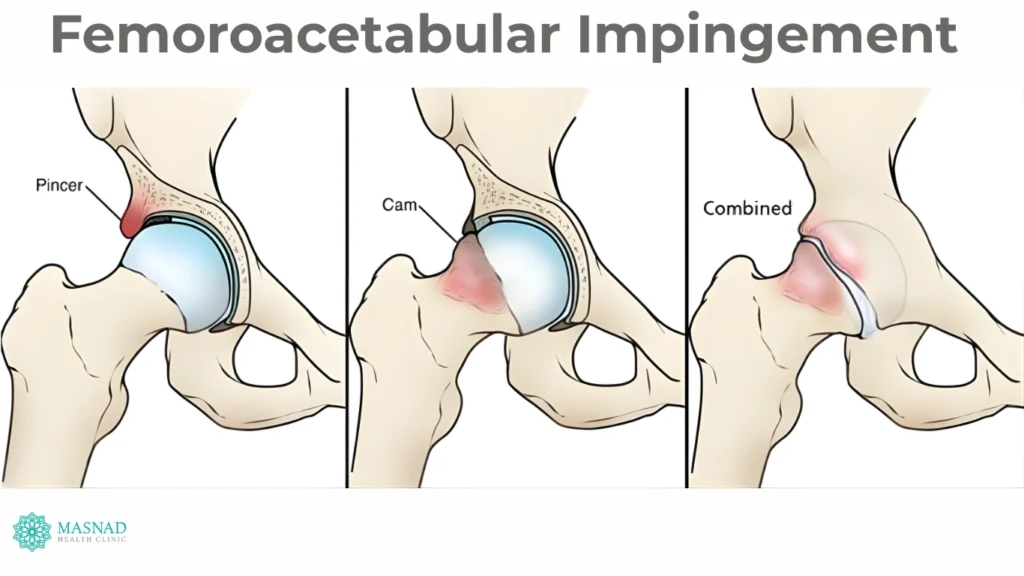

Femoroacetabular Impingement

What Is Femoroacetabular Impingement?

The hip joint is a ball-and-socket joint designed to move freely without friction. In FAI, structural changes occur in the ball, the socket, or both, causing the two surfaces to rub together abnormally.

FAI comes in three forms:

  • Cam Impingement

The femoral head is not perfectly round or has a small bump.
More common in men.

  • Pincer Impingement

The acetabular rim (socket) extends too far, causing the femoral neck to bump against it.
More common in women.

  • Mixed Impingement

Around 85% of patients have a combination of both cam and pincer types.

These changes can irritate joint structures like cartilage or the labrum, leading to hip or groin pain.

Symptoms of Femoroacetabular Impingement

FAI symptoms can develop gradually. Some individuals may never notice symptoms, but many experience:

  • Deep hip or groin pain
  • Stiffness or reduced hip flexibility
  • Pain spreading to the buttock or thigh
  • A dull ache that gets worse with activity
  • A feeling of catching, clicking, locking or giving way

Limping or difficulty walking long distances

What Does FAI Pain Feel Like?

Patients often describe it as a deep bruise-like pressure inside the hip, which worsens with:

  • Squatting or lunging
  • Running or jumping
  • Prolonged sitting
  • Twisting motions
  • Lying on one side

What Causes Femoroacetabular Impingement (FAI)?

FAI can occur due to structural or lifestyle factors, including:

  • Hip dysplasia or abnormal hip formation in childhood
  • Repetitive stress on the hip (sports, heavy activity)
  • Malunion of a previous femoral neck fracture
  • Small bony growths (osteophytes)
  • Natural anatomical variations
  • Genetic predisposition

How Can Physiotherapy Help?

Physiotherapy plays an important role in reducing pain, improving hip function, and preventing long-term joint damage.

Treatment may include:

  • Strengthening exercises for the hip and lower limb
  • Core stability and pelvic control training
  • Improving neuromuscular coordination
  • Postural and movement correction
  • Hydrotherapy to reduce joint load
  • Activity modification advice
  • A personalised home exercise program

Most people respond well to conservative care. However, if symptoms persist, surgery may be recommended. Hip arthroscopy is the most common procedure, and physiotherapy is essential before and after surgery to optimise recovery.

Always seek professional advice for your specific condition.

Why Choose Masnad Health Clinic?

  • Experienced physiotherapists specialising in hip conditions
  • Evidence-based treatment tailored to your lifestyle and goals
  • State-of-the-art rehabilitation programs
  • Holistic approach focusing on strength, mobility, and long-term wellness
  • Support for both conservative and post-surgical recovery
  • Compassionate care in a comfortable, patient-focused environment

Conclusion

Femoroacetabular Impingement can cause significant hip pain and limit your daily activities, but with early diagnosis and a personalised physiotherapy plan, you can reduce pain, restore mobility, and protect your joint for the future.

For all your Femoroacetabular Impingement needs, feel free to call us on 02 9793 8840 or book your appointment online to begin your journey toward long-lasting comfort and improved hip function.

FAQ

Yes, untreated FAI can increase the risk of developing hip osteoarthritis over time.

No. Many people improve significantly with physiotherapy and lifestyle modification.

Deep squats, twisting movements, prolonged sitting, and crossing legs may worsen symptoms.

With consistent treatment, many patients see improvement within 6–12 weeks.

Yes, it can affect one or both hips depending on structural variations.