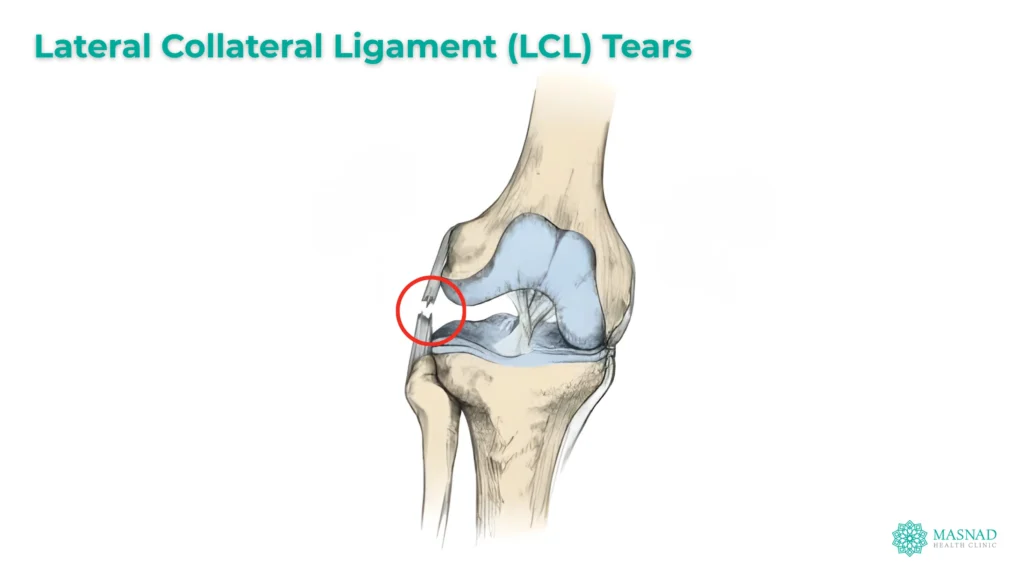
What is a Lateral Collateral Ligament (LCL) Injury?
The lateral collateral ligament (LCL) is located on the outer side of your knee, connecting the femur (thigh bone) to the fibula (shin bone). Its main role is to stabilise the knee, especially against sideways forces.
Injuries to the LCL can vary in severity:
- Grade I (Mild Sprain): Slight stretching of the ligament with minor instability
- Grade II (Partial Tear): Some fibres are torn, leading to moderate pain and instability
- Grade III (Complete Tear): Full rupture of the ligament causing significant instability
LCL injuries account for 7-16% of all knee ligament injuries, and they often occur alongside damage to other knee ligaments, such as the ACL or PCL.
What Causes an LCL Tear?
The LCL is designed to resist varus stress – forces that push the knee outward. Injuries typically occur when:
- The foot is planted and the knee experiences a sudden twist
- A direct blow hits the inside of the knee
- Rapid changes of direction in sports create rotational stress
Sports with higher risk include:
- Soccer
- Basketball
- Football
- Skiing
Traumatic incidents, like falls or vehicle accidents, can also cause LCL tears.
Symptoms of an LCL Injury
Symptoms depend on the severity of the tear:
- Pain, warmth, or swelling on the outer knee
- Stiffness or reduced range of motion
- Feeling that the knee “gives way”
- Difficulty with lateral movements or twisting
- Knee locking in severe cases
Mild sprains may present minimal symptoms, while complete tears often cause noticeable instability and pain.
Diagnosis
A thorough physiotherapy assessment is essential. Your physiotherapist will:
- Check ligament stability with specific tests (e.g., varus stress test)
- Assess range of motion and knee strength
- Review your movement patterns and activity level
If needed, imaging like an MRI or X-ray may be recommended to confirm the tear’s severity and check for other injuries.
Treatment
Treatment depends on the grade of the injury.
Mild to Moderate LCL Injuries (Grades I-II)
- Rest and activity modification
- Ice therapy to reduce swelling
- Knee bracing or splinting for support
- Targeted exercises to restore knee range of motion
- Strengthening of surrounding muscles
- Proprioceptive training to improve balance and joint control
Severe LCL Injuries (Grade III)
- Surgery may be required to repair or reconstruct the ligament
- Post-surgical rehabilitation is essential for restoring strength, stability, and mobility
Recovery timelines vary:
- Conservative treatment: Return to sport in approximately 6-8 weeks
- Surgical cases: Longer rehabilitation depending on procedure and healing
Prevention
Preventing LCL injuries is challenging due to their sudden, high-impact nature. However, you can reduce risk by:
- Following sports safety guidelines
- Regular leg and hip strengthening
- Maintaining flexibility and joint mobility
- Using proper techniques in training and sport
How Masnad Health Clinic Can Support You
At Masnad Health Clinic, our physiotherapists provide thorough assessment and personalised treatment for knee ligament injuries, including LCL tears.
We focus on:
- Identifying the underlying cause of instability
- Reducing pain and inflammation safely
- Restoring knee strength and mobility
- Rebuilding balance and proprioception
- Providing clear guidance throughout recovery
Our multidisciplinary approach ensures the entire movement system is considered – not just the knee.
Book an Appointment
If you are experiencing knee pain or instability:
Book your appointment online today
Or call us on (02) 9793 8840
Early assessment can prevent further damage and support faster recovery.
We proudly support the communities of Bankstown, Lakemba, Punchbowl, Greenacre, Chullora and Yagoona with professional, personalised physiotherapy care.